

Medical Rx and Infusions: The Overlooked Side of High-Cost Rx
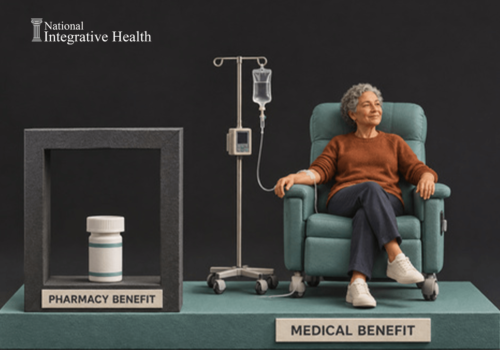
As plans build their high-cost Rx strategy for 2027, the drugs paid under the medical benefit are often the part left out. They shouldn’t be.
By Jake Velie, CPT | Founder, Chairman & CEO, National Integrative Health
Most conversations about high-cost drugs start with the pharmacy benefit, and for good reason. Specialty medications make up only about 2% of pharmacy volume but roughly 55% of pharmacy spending, according to the UnitedHealthcare 2026 Health Trends Report.
But a large share of high-cost drug spend never touches the pharmacy benefit at all. Infusions and injectables given in hospital outpatient departments, infusion centers and physician offices are billed on medical claims, usually under J-codes. When drugs paid through the medical benefit are included, WTW estimates that pharmacy accounts for approximately 36% of total healthcare claims, with pharmacy costs expected to rise 11.5% in 2026.
For plans building a 2027 strategy, that matters. A strategy that manages only pharmacy claims is managing only part of the problem.
Why Medical Rx Gets Missed
Medical-benefit drugs are easy to overlook for structural reasons:
- They’re billed like procedures. The drug cost is often bundled with administration and facility charges, which makes it harder to see what the drug itself costs.
- They sit outside the PBM’s view. Pharmacy benefit managers typically see pharmacy claims, not infusions billed through the medical plan.
- They’re reviewed by different people. Medical claims and pharmacy claims are often managed by separate teams, vendors, and reports.
- They show up late. By the time a large infusion claim reaches stop-loss reporting, the cost decisions have already been made.
The result is a blind spot in exactly the place where costs are growing. UnitedHealthcare reports that the cost of claims over $100,000 rose 12.9% from 2024 to 2025 across its self-funded and fully insured books (UnitedHealthcare).
Site-of-Care: Where the Opportunity Is Largest
Where an infusion is given can change its cost dramatically. Hospital outpatient departments remain the highest-cost setting, while home and ambulatory infusion consistently cost less, according to Optum. Optum cites a 2026 matched cohort study in the Journal of Managed Care & Specialty Pharmacy, which found similar clinical outcomes in alternate sites of care, with total cost of care approximately 33% lower.
The differences show up at the drug level, too. A review of commercial claims for immunoglobulin therapy found the cost per infusion was 31% lower at home than in the outpatient setting, $3,293 compared with $4,745 (AJMC).
Site-of-care is a clinical decision first. Not every patient or therapy is right for an alternate setting, and changes should be coordinated with treating providers. But in my experience, many plans have never looked at where their infusions are happening, let alone whether a lower-cost setting would be appropriate.
Moving patients is only part of a site-of-care strategy, though. Some patients need to stay in the hospital outpatient setting, at least for a time, and they are often the most complex and most expensive cases. At National Integrative Health, our Managed Care business manages infusions, injectables and oral therapies. When care has to stay in the hospital outpatient setting, we oversee the treatment and medication ordering and negotiate the cost of treatment until care can be moved to a more appropriate setting.
The results of any infusion strategy depend on how many treatments it can actually reach. Drawing on NIH’s plan design expertise and in-house managed care networks, we can manage 100% of a plan’s infusions, in every care setting. Most non-integrated vendors manage only a portion, which leaves the most critical cases, often the ones that must stay in the hospital, unmanaged.
What a Medical Rx Review Looks Like
Beyond site-of-care, a review of medical-benefit drug claims should check a few basics:
- Billed units match the dose actually administered
- Drug pricing is reasonable compared with available benchmarks
- The same therapy isn’t being paid under both the medical and pharmacy benefits
- Biosimilars or clinically equivalent alternatives have been considered where appropriate
Five Steps for 2027
For plans preparing for the 2027 plan year, here is a practical starting point:
- Pull 12 months of medical claims with J-codes and rank the drugs by total spend.
- Map where each therapy is administered: hospital outpatient, physician office, infusion center or home.
- Identify site-of-care opportunities and review them with treating providers. For therapies that must stay in the hospital, make sure ordering and treatment costs are still managed.
- Review billing and pricing on the highest-cost claims.
- Bring stop-loss into the conversation early, so the carrier understands how medical Rx is being managed before renewal.
The Bottom Line
A durable high-cost Rx strategy brings pharmacy, medical and PBM spend into one view. Infusions and other medical-benefit drugs are often where the largest single claims sit, and where the most practical opportunities are. The strongest strategies reach every infusion in every setting, including the cases that have to stay in the hospital. Plans that build that into their 2027 planning will be working from the full picture, not just part of it.
About the Author
Jake Velie, CPT, is Founder, Chairman & CEO of National Integrative Health, an integrated pharmacy program for high-cost medications that serves plan fiduciaries with full transparency. He writes regularly on high-cost drug management for benefits professionals. The NIH team will be at the 19th Annual HVBA Conference at the Logan Inn in New Hope on November 19.
Sources
UnitedHealthcare, A prescription for easing the pain of pharmacy care costs: https://www.uhc.com/employer/news-strategies/prioritizing-pharmacy-care-costs
WTW 2026 Best Practices in Healthcare Survey (via Morningstar/GlobeNewswire): https://www.morningstar.com/news/globe-newswire/9855110/wtw-2026-best-practices-in-healthcare-survey-us-employer-healthcare-costs-set-to-rise-at-fastest-pace-in-more-than-two-decades
UnitedHealthcare 2026 Health Trends Report: https://www.uhc.com/agents-brokers/employer-sponsored-plans/news-strategies/annual-health-trends-report
Optum, Why site of care strategy matters in infusion therapy: https://business.optum.com/en/insights/site-of-care-strategy-infusion-therapy.html
AJMC, Managing Cost of Care and Healthcare Utilization in Patients Using Immunoglobulin Agents: https://www.ajmc.com/view/managing-cost-of-care-and-healthcare-utilization-in-patients-using-immunoglobulin-agents