

The Data You Cannot See Is Costing You More Than the Data You Can

By Jake Velie, Chairman & CEO, National Integrative Health
The National Alliance of Healthcare Purchaser Coalitions just released its 2026 Pulse of the Purchaser survey, and if you run a self-funded health plan, you should read it carefully.¹
Not because it says anything surprising about costs. Costs are up. Everyone knows that. The average employer expects a 7.7% increase before plan design changes, and one in three projects 9% or more. That has been the background noise for years.
What makes this year’s data important is what it says about who actually does something about it, and why.
The answer is not what most people assume.
Cost Pressure Does Not Predict Action
Here is the finding that should stop every benefits leader in their tracks: employers facing the steepest cost increases are not significantly more likely to have purchasing strategies in place.¹
Read that again.
The employers getting hit hardest are not the ones doing the most. Employers paying above-average premiums are not doing more either. Neither cost level nor cost trajectory predicts whether an employer is actually managing spend.
So, what does?
Data access.
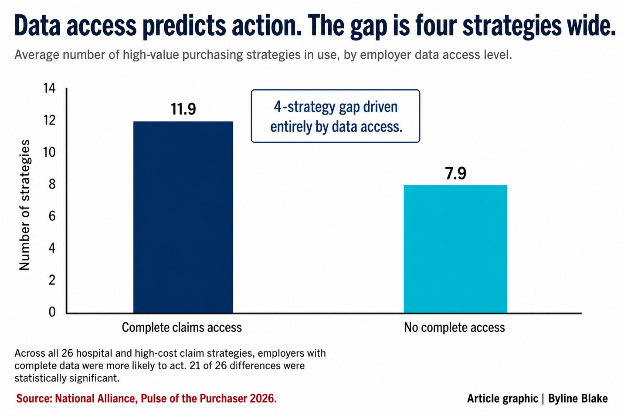
Employers with complete claim-level access to their medical data are running an average of 11.9 high-value purchasing strategies. Employers without that access are running 7.9.¹ That is a four-strategy gap driven entirely by whether the employer can see what is happening inside its own plan.
Across all 26 hospital and high-cost claim strategies measured in the survey, employers with complete claims data were more likely to be taking action. Every single one pointed the same direction. Twenty-one of the twenty-six differences were statistically significant.¹
This is not a minor methodological footnote. This is the central finding of the largest employer health purchasing survey in the country.
The Gap Is Not Intent. It Is Information.
Both groups of employers express similar levels of interest in managing costs. They are considering roughly the same number of strategies. The difference is that employers with data convert interest into action at dramatically higher rates.
As one respondent put it: “Even if I did have access to our data, I don’t know that I have the capacity to review and make decisions.”¹
That quote is important because it captures both sides of the problem. Access is necessary but not sufficient. Employers also need the operational support to translate claims intelligence into purchasingdecisions. But without access, the conversation never starts.
Roughly one in three employers in the survey report they do not have complete claim-level access to their medical data.¹ Only about three in five are confident they can audit their own complete files. And where the data is stored matters: three-quarters of employers keep claims with their health plan or TPA, and that group reports the lowest access rates. Employers using an independent data warehouse report access rates above 84%.¹
The practical implication is straightforward. If your claims data lives inside the same vendor relationship you are trying to evaluate, you are less likely to have unfettered access to it. And if you do not have access, you are less likely to act.
Where the Money Goes
For the first time, the survey asked employers to estimate how their healthcare dollars are allocated. The results confirm what many plan sponsors suspect but have not documented:
Hospital and facility costs account for 30.5% of total spend.¹ Prescription drugs take 21.1%. Professional fees account for 19.1%.
But here is the number worth dwelling on. The National Alliance estimates that when hospital-affiliated professional fees and physician-administered drugs billed through hospital systems are included, hospital services approach half of every dollar employers spend on healthcare.² That is not a fringe claim. That is the survey sponsor’s own analysis, and it aligns with what we see in high-cost claim reviews every week.
If hospitals are consuming close to half the spend, and only 30% of employers regularly use hospital price and quality information to guide purchasing decisions,¹ the gap between problem and response is enormous.
The most commonly reported barrier to using that information? Limited internal staff capacity.¹ Not lack of interest. Not disagreement with the approach. Capacity.
The PBM Market Is Moving, and the Data Explains Why
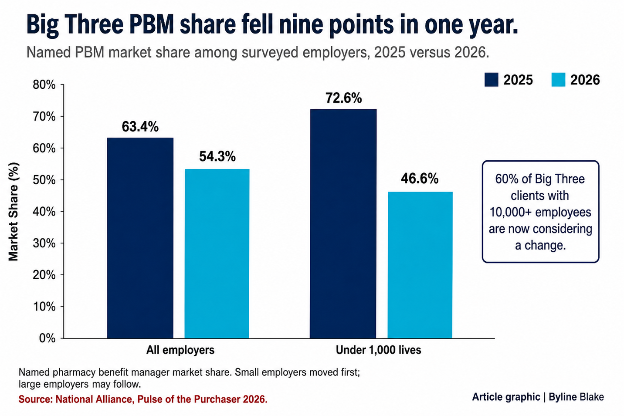
The survey documents a meaningful shift in PBM market share. Big Three PBM share of named pharmacy benefit managers fell from 63.4% in 2025 to 54.3% in 2026.¹ That is a nine-point decline in a single year.
The shift came almost entirely from employers under 1,000 lives, where Big Three share dropped 26 points.¹ Small employers moved first because they can move faster. But 60% of Big Three clients with 10,000 or more employees are now considering a change, suggesting the next wave could come from the largest purchasers.¹
What is driving it? Contract terms and fiduciary confidence.
On every contract protection measured except rebate pass-through, employers using non-Big Three PBMs report stronger terms: no spread pricing, disclosure of affiliated entities and compensation, and lowest-net-cost formulary design.¹ The gaps are consistent, ranging 16 to 18 percentage points.
Big Three clients are nearly three times as likely to question the integrity of PBM administration (36% versus 13%) and the reasonableness of PBM compensation (35% versus 12%).¹ And employers without full pharmacy claims access are more than twice as likely to express concern about both measures.
Opacity and distrust travel together. That is not speculation. That is what the data shows.
This matters in the context of new federal law. The Consolidated Appropriations Act of 2026 will require PBMs to pass through 100% of rebates and other remuneration beginning with plan years starting 30 months after February 3, 2026.³ For calendar-year plans, that generally means January 1, 2029. Employers should be evaluating their PBM contracts now against what that timeline will require.
Policy Engagement Is Rising Because Frustration Is Hardening Into Specific Asks
The survey documents something subtle but important: employer threat ratings are falling while support for regulation is rising.¹
Drug prices as a significant threat fell from 93% in 2024 to 77% in 2026. Hospital prices fell from 82% in 2023 to 68%.¹ But over the same period, support for PBM reform rose 20 points to 88%, and support for hospital rate regulation rose 17 points to 83%.¹
Those two trends moving in opposite directions tell you something. Employers are not less worried. They have moved past alarm and into specific policy demands. Frustration has hardened into targeted asks.
More than half of employers now engage in federal or state health policy, up nearly nine percentage points in a single year.¹ And once again, data access is the dividing line: employers with full pharmacy claims access are 22 percentage points more likely to participate in policy discussions.¹
The pattern is consistent. Data access predicts action. Data access predicts confidence. Data access predicts engagement. If you take one thing from this survey, it should be that the single most important investment a plan sponsor can make is ensuring unfettered access to its own claims data.
What This Means for Plan Sponsors
The survey identifies a clear hierarchy of what matters:
- Get complete access to your claims data. Medical and pharmacy, separately. Not aggregate reports. Not vendor-curated dashboards. Claim-level data with audit rights you can actually exercise.
- Store that data independently. Employers using independent data warehouses report access rates above 84%. Employers storing data with their health plan or TPA report rates near 59%.¹ Where the data lives determines whether you can use it.
- Use the data to evaluate, not just to report. Small employers use claims data for cost analysis. Large employers use it for vendor accountability, financial integrity review, and benchmarking.¹ Theprogression from tracking to governing is where value creation happens.
- Evaluate your PBM contract against the new federal standard. If your contract does not already include no spread pricing, full compensation disclosure, and lowest-net-cost formulary design, you are behind the market. The survey shows non-Big Three employers already have these protections at significantly higher rates.¹
- Treat site-of-care strategy as a first-order purchasing decision. Hospital and facility spend is the largest single category. More than half of employers are already steering members to higher-value sites or using centers of excellence.¹ If you are not among them, you are absorbing costs that other employers are managing.
The Uncomfortable Truth
This survey confirms something that should make every plan sponsor uncomfortable: the system is designed to limit your visibility.
Vendors who administer your claims also control your data access. PBMs whose compensation you cannot verify also design your formulary. Hospitals whose prices you cannot compare also dictate where care is delivered.
The employers who break through that design limitation are the ones who insist on data access, exercise audit rights, evaluate contract terms, and treat purchasing as an active discipline rather than a passive administrative function.
The 2026 Pulse of the Purchaser makes the case clearly: what separates employers who act from those who do not is not what they pay. It is what they can see.
If you cannot see your data, you cannot manage your plan. And if you are relying on the same vendors whose performance you need to evaluate to give you the information you need to evaluate them, you have a structural conflict that no dashboard will solve.
The question for every plan sponsor reading this is simple: do you have complete, independent access to your own claims data, and are you using it to hold every vendor relationship to account?
If the answer is no, that is where to start.

Jake Velie is Chairman & CEO of National Integrative Health, a managed services organization headquartered in West Des Moines, Iowa, specializing in prescription drug cost optimization for self-funded employer health plans.

Footnotes
- National Alliance of Healthcare Purchaser Coalitions. “Pulse of the Purchaser: 2026 Survey Findings.” Fielded May-June 2026, 408 respondents representing employers across all 50 states and DC, covering approximately 3.7 million lives. https://www.nationalalliancehealth.org/resources/pulse-of-the-purchaser-2026-survey-results/
- National Alliance of Healthcare Purchaser Coalitions. “Setting the Record Straight: A Challenge to Align Hospital Prices with Value.” 2026. The Alliance estimates that when hospital-affiliated professional fees and physician-administered drugs billed through hospital systems are included, hospital services approach half of every employer healthcare dollar.
- Consolidated Appropriations Act, 2026, H.R. 7148, 119th Congress, enacted February 3, 2026. Requires PBMs to pass through 100% of rebates and other remuneration beginning with plan years starting 30 months after enactment (August 3, 2028). For calendar-year plans, this requirement would generally begin January 1, 2029.