

PBMs Keep Putting It in Writing: They Are Not the Fiduciary
By Jake Velie, Chairman & CEO, National Integrative Health
The most important sentence in some PBM paperwork is not buried in the pricing exhibit. It is not in the rebate schedule. It is not in the reporting package.
It is the disclaimer.
In one PBM pharmacy service agreement reviewed by our team, the language is direct: in providing services under the agreement, the PBM “is not acting as a fiduciary” under ERISA, and the client “shall not name” the PBM “as a plan fiduciary.”¹ That is not unusual. It is honest contract drafting. But it should get every self-funded employer’s attention.
Why? Because the plan sponsor still holds the liability, even while the PBM controls a huge amount of the machinery.
PBMs adjudicate claims. They build networks. They negotiate rebates. They issue reports. They manage specialty channels. They influence formularies and utilization patterns. But when it comes to fiduciary responsibility, many of them are telling employers exactly where they stand: not here.
What one PBM does well
To be clear, this is not a hit piece on any single company. The agreement and reporting package we reviewed show a PBM doing a number of operational things employers need done.
The contract lays out claims processing, network administration, customer service, implementation support, audits, reporting, specialty pharmacy services, and rebate administration.² The fee schedule is straightforward enough to tell the client what it will pay for paid claims, prior authorizations, reporting requests, and other administrative functions.³ The agreement also states that the manufacturer’s rebate share to the client is 100%.³
The reporting itself is also the kind of visibility many employers say they want. The 2025 and Q1 2026 client summary reports show plan spend, member spend, rebates, net plan spend, generic utilization, specialty concentration, and other utilization markers.⁴ That is useful information. Employers need reporting. They need operational execution. They need a PBM that can keep the benefit running.
But here is the mistake too many plan sponsors still make: they confuse administration with alignment.
A clean report is not a fiduciary strategy. A rebate line is not a fiduciary strategy. A contract that spells out responsibilities is not the same as a partner taking fiduciary responsibility off your plate.
It does not.
The sentence employers cannot ignore
ERISA does not let a plan sponsor shrug and point downstream. The fiduciary standard follows the employer’s role in managing plan assets and plan decisions.⁵ If your PBM agreement says the PBM is not the fiduciary, believe it.
That means the employer still owns the hard questions:
- Are we paying the lowest net cost available for this drug?
- Are rebate economics distorting our decision-making?
- Are we overusing high-cost sites of administration?
- Are there lower-cost biosimilar or therapeutic alternatives?
- Are we using Manufacturer Assistance Programs (MAP), foundation support, and patient assistance opportunities where appropriate?
- Do we have a documented process showing we evaluated those alternatives?
That last point matters more every year. The Consolidated Appropriations Act forced more disclosure into the pharmacy benefit system, but disclosure alone does not satisfy fiduciary duty.⁶ Transparency tells you where the problem is. You still need a solution.
Reporting does not equal optimization
The summary reports make the point for me.
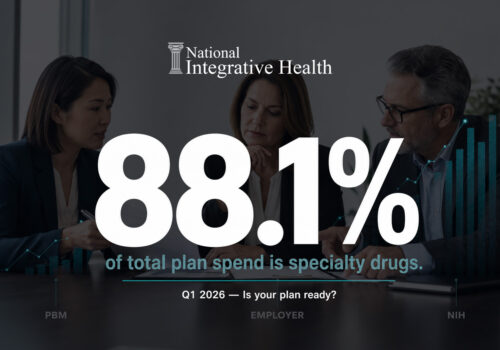
In the 2025 report reviewed by NIH, specialty plan spend accounted for 71.6% of total plan spend.⁴ In Q1 2026, that figure rose to 88.1%.⁴ Those are not abstract numbers. That is concentration risk. That is exactly why employers cannot afford to look at pharmacy through a single-channel PBM lens.
Even with rebates reflected in the reporting, the employer still needs an independent strategy for where each claim should go and which levers should be pulled. If specialty utilization is dominating spend, the employer cannot be satisfied with getting a quarterly report and hoping the economics work themselves out.
At NIH, we take the opposite view. We assume every high-cost claim deserves to be challenged.
Where NIH changes the equation
National Integrative Health is not trying to become the PBM. We are the managed services layer that sits on the employer’s side of the table.
It is also important to be clear about what we are not. NIH is not the plan fiduciary. The employer still holds that responsibility. Our role is to help plan sponsors meet it with better oversight, better documentation, and better net-cost execution.
That matters because our job is not to protect a single channel. Our job is to drive the lowest net cost across all available channels.
That means looking at 340B pricing, biosimilar pathways, site of administration optimization, Manufacturer Assistance Programs (MAP), clinical interventions, foundation and patient assistance advocacy, and clinical trial access.⁷ ⁸ We are not dependent on a single regulatory outcome or a single vendor revenue model. We are focused on the employer’s result.
So, when a PBM contract says, in effect, “we administer the program but we are not the fiduciary,” our response is simple: then the employer needs someone on its side who is actually waking up every day thinking like an owner.
That is where NIH fits.
This is a partner model, not a replacement fantasy
Employers do not need to blow up their ecosystem to fix this problem.
Brokers still matter. TPAs still matter. PBMs still matter. Auditors and consultants still matter.
But each of those partners has a different role.
Brokers connect plan sponsors to expertise. TPAs handle claims administration. PBMs process the pharmacy benefit and related operations. Auditors test the math and the compliance record. NIH helps the employer prove it asked the right questions, evaluated the right alternatives, and pursued the lowest net cost available.
That is the gap I see again and again in this market. Plenty of reporting. Plenty of vendors. Plenty of activity. Not enough employer-side orchestration.
Do not wait for the contract to save you
If your PBM has already told you in writing that it is not the fiduciary, take that statement seriously.
Do not wait for another lawsuit, another regulatory bulletin, or another renewal cycle to start building your fiduciary record. Start now. Review the contract language. Review the reporting. Review where specialty dollars are going. Then put a managed services strategy in place that proves you pursued the lowest net cost, not just the most convenient status quo.
The employers who get ahead of this will not be the ones with the prettiest PBM dashboard. They will be the ones who can show they understood the risk, challenged the model, and acted.
That is the standard now. And it should be.
Jake Velie is Chairman & CEO of National Integrative Health, a managed services organization headquartered in West Des Moines, Iowa, specializing in prescription drug cost optimization for employer health plans.

Footnotes
- PBM pharmacy service agreement reviewed by NIH, effective April 1, 2017, Article VI, Section 6.2. Source material on file.
- PBM pharmacy service agreement reviewed by NIH, effective April 1, 2017, Exhibit A, Scope of Services. Source material on file.
- PBM pharmacy service agreement reviewed by NIH, effective April 1, 2017, Exhibit B, Administrative Fee Schedule, including claims processing fee and manufacturer rebate share to client. Source material on file.
- 2025 and Q1 2026 client summary reports reviewed by NIH. Source material on file.
- Employee Retirement Income Security Act of 1974, 29 U.S.C. § 1002(21)(A), defining fiduciary functions under ERISA.
- Consolidated Appropriations Act, 2021, Pub. L. No. 116-260, Division BB, Title II, establishing prescription drug cost reporting and related transparency obligations for group health plans and issuers.
- National Integrative Health, “About Us,” describing NIH’s managed services model for prescription drug cost optimization. https://nationalintegrativehealth.com/
- Magellan Rx Management, “Medical Pharmacy Trend Report: Site of Care Optimization,” describing savings potential from shifting infusion administration to lower-cost settings.