

Caribou Systems Is Asking the Right Question, and Plan Sponsors Should Listen
By Jake Velie, CEO & President, National Integrative Health
Caribou Systems recently published a piece that every self-funded plan sponsor should read: “You’re the Fiduciary. Can You Prove It?” It’s a direct, uncomfortable question, and that’s exactly why it matters.¹
Their argument is simple and correct: ERISA fiduciary compliance isn’t about outcomes. It’s about process. Specifically, can you produce an independent, time-stamped trail showing you were actively verifying your pharmacy benefit spend, catching errors, and acting on what you found? For most plans, the answer is still no.
What Caribou Does
What Caribou Systems does is rare in this industry: they tell plan sponsors the truth about their exposure and then give them the tools to close the gap. Their re-adjudication engine audits 100% of pharmacy claims (not a statistical sample), they conduct 75+ pre-implementation audits annually, and they process over 200 million claims per year.² That’s not a compliance checkbox. That’s a real oversight infrastructure.
Their emphasis on independence is critical. As they correctly point out, PBM-provided reporting, however detailed, is not independent verification. The Consolidated Appropriations Acts of 2021 and 2026 gave plan sponsors the legal standing to demand raw claims data and expanded audit rights, but having data is not the same as having a defensible fiduciary record.³ ⁴ Caribou builds that record.
Where National Integrative Health Fits
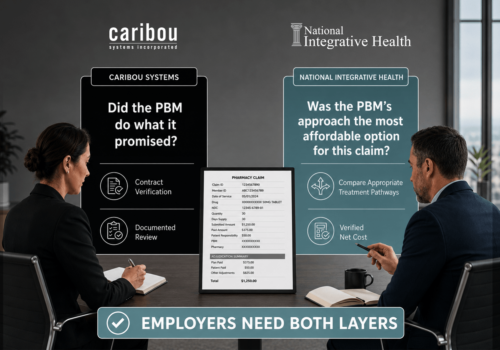
At NIH, we view organizations like Caribou as natural allies. Our work operates on a parallel track: while Caribou ensures your PBM is billing correctly, disclosing rebates fully, and applying benefit terms accurately, NIH ensures you’re achieving the lowest possible net cost on every claim in the first place.⁵
We deploy a multi-lever approach: 340B pricing across all 50 states, biosimilars delivering 60–80% savings, site of administration optimization reducing infusion costs by 40–60%, variable copay programs for GLP-1s and specialty medications, clinical interventions, and clinical trial program access.⁵ ⁶
These aren’t competing strategies. They’re complementary layers of a complete fiduciary posture. Caribou asks: “Is your PBM doing what they said they’d do?” NIH asks: “Is the PBM model even the best structure for this claim?” Both questions must be answered.
The Litigation Environment Demands Both
Caribou’s article flags the ERISA lawsuits filed against Johnson & Johnson, Wells Fargo, and JPMorgan over health benefit mismanagement.¹ What those cases reveal is that courts don’t just want to see that you caught billing errors. They want to see that you exercised the care of a knowledgeable professional across the entire pharmacy benefit, including whether you explored alternatives to the traditional PBM markup model.
A plan that can show both an independent claims audit trail and evidence that it pursued the lowest net cost through multiple sourcing channels is in a fundamentally different position than one relying solely on PBM-provided reports and a broker’s annual review.
Don’t Wait for Regulation
DOL Secretary nominee Keith Sonderling has made PBM transparency a stated priority, and new regulations are in motion.⁷ But as I’ve said before: transparency tells you where the problem is. You still need solutions. The smartest plan sponsors aren’t waiting for regulators to hand them a playbook. They’re building their fiduciary record now, with partners like Caribou handling the audit and verification layer, and organizations like NIH driving the actual cost optimization.
Caribou Systems is doing important work. If you’re a self-funded plan sponsor and you can’t answer the five questions in their article, start there. Then call us to make sure the dollars flowing through that system are optimized from the ground up.
Jake Velie is Chairman & CEO of National Integrative Health, a managed services organization headquartered in West Des Moines, Iowa, specializing in prescription drug cost optimization for employer health plans.
Footnotes
¹ Caribou Systems. “You’re the Fiduciary. Can You Prove It?” MyHealthGuide, July 16, 2026.
² Caribou Systems. Company overview: audits 200 million+ pharmacy claims annually, conducts 75+ pre-implementation audits per year, and provides 100% claims re-adjudication for independent fiduciary documentation. https://www.caribousystems.com
³ Consolidated Appropriations Act of 2021, Pub. L. No. 116-260, Division BB, Title II (Transparency provisions requiring PBM disclosure of rebates, fees, and prescription drug cost reporting by group health plans).
⁴ Consolidated Appropriations Act of 2026 (Expanded audit rights and regulatory obligations for self-funded plan sponsors to act on pharmacy benefit data).
⁵ National Integrative Health. “About Us.” NIH is a managed services organization that deploys a multi-channel approach to achieve the lowest net cost on every pharmacy claim for employer health plans. https://www.nationalintegrativehealth.com/
⁶ Magellan Rx Management. “Medical Pharmacy Trend Report: Site of Care Optimization.” Shifting infusion administration from hospital outpatient departments to lower-cost settings can reduce per-administration costs by 40–60%.
⁷ Bell, Allison. “DOL Secretary Nominee Calls PBM Transparency a ‘Priority.'” BenefitsPro, July 17, 2026.