

Case Study: Seamlessly Reducing High-Cost Pharmacy Spend Without Disrupting Member Care
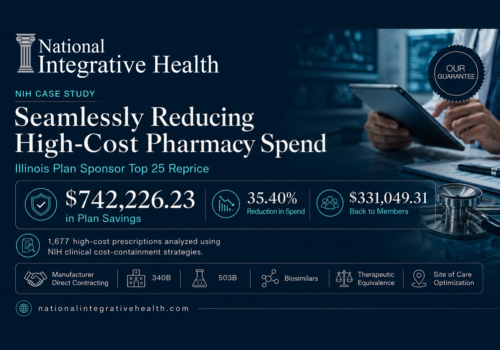
Client Snapshot: The Illinois Plan Sponsor Top 25 Reprice
An Illinois Plan Sponsor was facing a growing challenge with high-cost pharmacy claims. A small group of prescriptions was driving significant plan spend, and the company needed a clearer way to identify savings without disrupting employees who depended on these medications.
NIH analyzed 1,677 claims of The Illinois Plan Sponsor’s Top 25 high-cost prescriptions using the NIH MSO Network and clinical cost-containment strategies, including:
· Manufacturer Direct Contracting
· Formulary Optimization 340B opportunities
· Clinical Trials
· 503B options
· Biosimilars
· Therapeutic equivalence
· Site of Care Optimization
· The analysis also included a 20% rebate weight to reflect plan economics more realistically.
The Problem: High-Cost Pharmacy Spend with Limited Transparency
Like many employers and plan sponsors, The Illinois Plan Sponsor was dealing with rising pharmacy costs and limited transparency into whether prescriptions were being filled at the lowest possible net cost.
The client’s concern was not only cost. They also wanted to understand what would happen to members already taking high-cost medications.
Would members lose access?
Would they experience disruption?
How would they transition into a new pharmacy strategy without confusion or delays?
The core question was simple:
How do we bring costs down while making sure employees still receive the medications they need?
The Solution: NIH Technology, Repricing, and manufacturer direct contracting
NIH stepped in and provided a transparent repricing analysis to show the client where savings could be achieved immediately.
Through NIH’s technology-driven pharmacy solution, the client was able to see how high-cost drug spend could be reduced by identifying the lowest net cost of acquisition and applying smarter pharmacy management strategies.
NIH reviewed every member, every transaction, and every opportunity for savings. The solution included manufacturer direct contracting options, biosimilar strategies, and therapeutic equivalents where clinically appropriate.
This included:
· Auditing claims for the lowest net cost of acquisition
· Reviewing high-cost medications for generic, biosimilar, or therapeutic equivalent alternatives
· Leveraging manufacturer direct, 340B, and 503B sourcing opportunities
· Running a biosimilar and generic strategy where appropriate
· Working directly with physicians when a lower-cost equivalent was available
· Proactively communicating with members before disruption occurred
· Managing the transition so employees continued receiving the medications they needed
The Savings: Lower Plan Spend and More Money Back to Members
The NIH reprice showed immediate and meaningful savings potential.
By analyzing 1,677 prescriptions across the Top 25 high-cost drugs, NIH identified that The Illinois Plan Sponsor could save:
$742,226.23 in plan savings
That represents a:
35.40% reduction in spend
In addition, NIH’s strategy would put:
$331,049.31 back into members’ pockets
This means the solution did more than reduce employer and plan costs. It also created meaningful savings for employees and their families.
The Member Experience: Seamless, Proactive, and Protected
One of The Illinois Plan Sponsor’s biggest concerns was the member experience.
NIH’s process was designed to be seamless. Members already taking high-cost medications were not left to figure things out on their own. Instead, they received proactive communication and support throughout the transition.
When a lower-cost generic, biosimilar, or therapeutic equivalent option was available, NIH worked with the doctor to help make the change in a clinically appropriate way. When a member needed to remain on a medication, the focus stayed on ensuring access while still managing cost intelligently.
The goal was never to take medications away from employees.
The goal was to make sure the plan was not overpaying for those medications.
The Result: High-Cost Drug Spend Came Down While Employees Stayed Protected
Using NIH’s technology, repricing tools, manufacturer direct contracting, and high-cost claim management strategy, The Illinois Plan Sponsor was able to identify substantial savings while maintaining access to critical medications.
The client gained:
· Immediate visibility into potential savings
· A projected $742,226.23 in plan savings
· A 35.40% reduction in pharmacy spend
· A projected $331,049.31 returned to members
· A clearer understanding of where high-cost pharmacy spend was concentrated
· A seamless implementation strategy
· Better oversight of every pharmacy transaction
· A smarter approach to biosimilars, therapeutic equivalents, and manufacturer direct contracting
· Lower drug spend without unnecessary member disruption
The Takeaway
High-cost pharmacy spend does not have to remain unpredictable or uncontrollable.
With NIH, The Illinois Plan Sponsor moved from limited transparency and rising costs to a smarter, technology-driven pharmacy strategy that showed measurable savings from day one.
NIH did not just tell the client they could save money.
NIH showed the savings, identified the opportunities, and created a seamless path to bring high-cost drug spend down while ensuring employees continued to receive the medications they needed.
That is the power of one in-house team delivering a fully integrated managed care model.
Contact Information:
National Integrative Health
Jenny Jenkinsl, Global Brand Ambassador
jjenkins@nationalintegrativehealth.com
www.nationalintegrativehealth.com